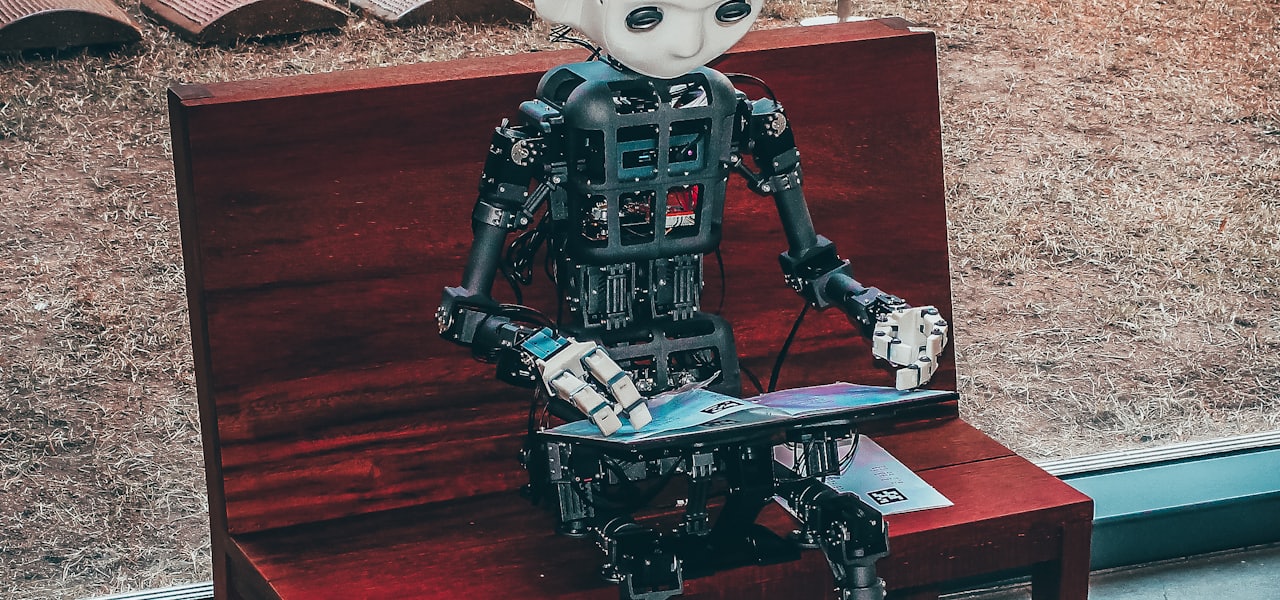
A deadbot, deathbot, or griefbot is a digital avatar, created with artificial intelligence, which resembles a person who is dead. Griefbots employ natural language processing and machine-learning techniques to approximate the style and personality of a deceased person. They may appear as chatbots, voice assistants, or animated avatars, and are often trained on an individual's digital remains. == History == Among the earliest researchers, Muhammad Aurangzeb Ahmad of the University of Washington, developed the Grandpa Bot project, a conversational simulation of his late father designed for his children to interact with. Other efforts include journalist James Vlahos's Dadbot, which evolved into the commercial platform HereAfter AI. Hossein Rahnama's Augmented Eternity research at MIT Media Lab and Toronto Metropolitan University, and game designer Jason Rohrer's "Project December", have enabled users to converse with language-model representations of loved ones. Early commercial projects such as Eternime, founded by Marius Ursache, also popularized the notion of interactive digital immortality. == Cultural and societal impact == Scholars have proposed frameworks and critiques addressing the ethics of these technologies. Tomasz Hollanek and Katarzyna Nowaczyk-Basińska developed a design-ethics taxonomy distinguishing the data donor, data recipient, and interactant. Edina Harbinja and Lilian Edwards formalized the concept of post-mortem privacy, and Carl J. Öhman at the Oxford Internet Institute studied the management of large-scale digital remains. Cultural acceptance varies: while some view them as expressions of remembrance, others regard them as unsettling or ethically problematic. Concerns have been raised about deadbots' potential for creating psychological harm. Griefbots are considered part of the phenomenon of artificial intimacy.
Imo.im
imo.im is a proprietary audio/video calling and instant messaging software service. It allows sending music, video, PDFs and other files, along with various free stickers. It supports encrypted group video and voice calls with up to 20 participants. According to its developer, the service possesses over 200 million users and over 50 million messages per day are sent through it. == History == The product was created as a web-based application in 2005 for accessing multiple chat platforms, including Facebook Messenger, Google Talk, Yahoo! Messenger, and Skype chat. It was developed by Pagebites, which is a subsidiary of Singularity IM, Inc. and required a subscriber's phone number to verify the users' account. In March 2014, support for all third-party messaging networks ended. In January 2018, the app reached 500 million installs. imo.im has implemented end-to-end encryption for its chats and calls, ensuring that the conversations remain private between the sender and receiver.
Puck App
Puck App is a mobile application that allows hockey players to quickly find and rent a hockey goalie. Founded in 2015 in Toronto, the application primarily operates throughout Canada. It is available on Apple's App Store and Google Play. == History == Puck App was founded in 2016 by Niki Sawni. Users can rate the goalies, message with available goalies, and coordinate skill levels. In 2017, Puck App expanded to Western Canada and has over 1,000 goalies registered. In 2018, Puck App charged approximately $40 CDN to rent a goalie with more than 2 hours notice. Previously, Puck App was a competitor to a similar application called GoalieUp. As of 2024, both companies have agreed to a merger deal.
Trebel (music app)
Trebel is an on-demand music download and discovery platform developed by M&M Media Inc. The company's business model aims to combat digital music piracy by giving users access to on-demand music at no cost while delivering fair compensation to artists and music rights holders. Trebel has a patent that allows it to market itself as the only international music service in which users can legally download music and listen to it offline for free. As of March 2023, Trebel has a catalog of 75 million songs from record labels such as Universal Music Group, Sony Music Entertainment, Warner Music Group and hundreds of independent labels. Trebel is based in Stamford, Connecticut. with additional locations in Mexico City, Jakarta, Bogota, Los Angeles and Miami. The app is available in the Apple App Store, Google Play Store, and Huawei AppGallery. == History == Trebel was founded in 2014 by Gary Mekikian, who was previously the co-founder of answerFriend, Inc., which commercialized web based question-answering technologies and merged with Electric Knowledge, forming InQuira. This company was eventually acquired by Oracle Corporation in 2011. His co-founders at Trebel include Stanford classmates Corey Jones and Luis Soto Durazo, as well as his daughters Grace and Juliette. Mekikian envisioned Trebel as an alternative to music piracy after a high school classmate of his daughters was targeted by cyberattackers while illegally downloading music online. Trebel was initially released in 2015 under the name Project Carmen to students at Ohio State, Santa Monica College, Cal State Fullerton, UCLA and Long Beach State. In its original incarnation, the service planned to target students at 3,000 universities and 30,000 high schools in the United States. A beta version of the app was introduced in 2016 with content from Universal Music Group and Warner Music Group. Trebel launched commercially in the United States and Mexico in 2018. In 2018, Mexican mass-media corporation Televisa also became a minority investor in Trebel. In May 2020, during the early months of the COVID-19 pandemic, Trebel was a digital broadcast partner for Se Agradece, a concert produced in Mexico by Televisa to honor frontline COVID workers that featured artists such as Rosalia, J Balvin, Maluma and Ricky Martin. In June 2021, Trebel reached 3 million monthly active users. In October 2021, Trebel signed a music licensing agreement with Merlin Network, the licensing agency for the independent music sector that controls an estimated 12% of the global digital recorded music market. In January 2022, Trebel announced a strategic alliance with MNC Corporation, an Indonesian media conglomerate, which also became a minority backer of the company. In March 2022, Trebel reported 5.2 million monthly active users as a result of growth in Latin America. In the same month,, Latin music star Maluma became a backer of Trebel and an advisor to Gary Mekikian, helping expand the service throughout Latin America. On April 18, 2022, Trebel launched in Indonesia during the finale of the music competition show X Factor Indonesia. Trebel also signed a deal that month with Soccer Media Solutions, a sports and entertainment marketing agency in Mexico, to sell Trebel’s premium advertising inventory through Soccer Media. In May 2022, Guillermo Ochoa, goalkeeper for the Mexican national soccer team, invested in Trebel and became an ambassador for the company. On October 2, 2022, Trebel collaborated with Musica Studios, one of the largest music companies in Indonesia, on the production of a music festival in Jakarta titled Trebel Music Fest. The event featured performances by top Indonesian music artists such as Noah, Nidji, and d'Masiv. In October 2022, Trebel launched in Colombia. The service reached 1.2 million monthly active users in Colombia six months after launching. In December 2022, Trebel collaborated with KFC in Indonesia on the release of a KFC digital music program using a product called Trebel Max. As part of the program, KFC customers who bought the Crazy Superstar Combo package at KFC received a subscription to Trebel Max for 30 days. Trebel announced the launch of Trebel AI in May 2023. Trebel AI uses ChatGPT-powered technology to generate playlists based on natural language queries from users. In Indonesia, the Trebel AI feature was announced during a broadcast of the show Indonesian Idol XII that took place on May 8, 2023. In July 2023, Trebel reached more than 13 million monthly active users. In November 2023, Trebel became a featured app on the Discord app directory. Discord users that add the Trebel bot to their servers have access to Trebel's on-demand music library and have the exclusive privilege of being DJ's during server sessions with up to 150 concurrent listeners. == Platform == === Features === Trebel has a patent that allows it to market itself as the only international music service in which users can legally download music and listen to it offline for free. As of March 2023, Trebel has a catalog of 75 million songs from record labels such as Universal Music Group, Sony Music Entertainment, Warner Music Group and hundreds of independent labels. Trebel offers unlimited music downloads that are playable in the app by registered users only. Offline listening is free to all users and not blocked by a paywall. Users can search for music based on song, artist, album, browsing friends' recent activity, and through other users' playlists. The app also offers free cloud storage for downloaded songs. Trebel also contains a feature called SongID, which identifies music being played nearby using a short sample, then offers it for download on the service. Podcasts are available for free listening on the service as well. === Business model === Trebel uses a business model that generates revenue from the sale of digital advertising as well as user interactions with branded experiences, and consumption of virtual goods within the app (akin to mobile games). The app also features a brand takeover feature called Trebel Max, which offers unlimited access in exchange for users engaging with experiences offered by specific brands. Trebel’s brand partners include Uber, KFC, Walmart, Coca-Cola, Amazon and P&G. === Content === In September 2022, Trebel secured an exclusive release of the song “Suara Hatiku” by Indonesian actress Amanda Monopo. As of March 2023, Trebel offers 75 million songs through licensing agreements with Universal Music Group, Sony Music Entertainment, Warner Music Group and global indie rights agency Merlin. == Awards == In 2023, Trebel won three Google Play awards including "Best App of 2023", "Best Everyday Essentials" and "Users' Choice".
Texture filtering
In computer graphics, texture filtering or texture smoothing is the method used to determine the texture color for a texture mapped pixel, using the colors of nearby texels (ie. pixels of the texture). Filtering describes how a texture is applied at many different shapes, size, angles and scales. Depending on the chosen filter algorithm, the result will show varying degrees of blurriness, detail, spatial aliasing, temporal aliasing and blocking. Depending on the circumstances, filtering can be performed in software (such as a software rendering package) or in hardware, eg. with either real time or GPU accelerated rendering circuits, or in a mixture of both. For most common interactive graphical applications, modern texture filtering is performed by dedicated hardware which optimizes memory access through memory cacheing and pre-fetch, and implements a selection of algorithms available to the user and developer. There are two main categories of texture filtering: magnification filtering and minification filtering. Depending on the situation, texture filtering is either a type of reconstruction filter where sparse data is interpolated to fill gaps (magnification), or a type of anti-aliasing (AA) where texture samples exist at a higher frequency than required for the sample frequency needed for texture fill (minification). There are many methods of texture filtering, which make different trade-offs between computational complexity, memory bandwidth and image quality. == The need for filtering == During the texture mapping process for any arbitrary 3D surface, a texture lookup takes place to find out where on the texture each pixel center falls. For texture-mapped polygonal surfaces composed of triangles typical of most surfaces in 3D games and movies, every pixel (or subordinate pixel sample) of that surface will be associated with some triangle(s) and a set of barycentric coordinates, which are used to provide a position within a texture. Such a position may not lie perfectly on the "pixel grid," necessitating some function to account for these cases. In other words, since the textured surface may be at an arbitrary distance and orientation relative to the viewer, one pixel does not usually correspond directly to one texel. Some form of filtering has to be applied to determine the best color for the pixel. Insufficient or incorrect filtering will show up in the image as artifacts (errors in the image), such as 'blockiness', jaggies, or shimmering. There can be different types of correspondence between a pixel and the texel/texels it represents on the screen. These depend on the position of the textured surface relative to the viewer, and different forms of filtering are needed in each case. Given a square texture mapped on to a square surface in the world, at some viewing distance the size of one screen pixel is exactly the same as one texel. Closer than that, the texels are larger than screen pixels, and need to be scaled up appropriately — a process known as texture magnification. Farther away, each texel is smaller than a pixel, and so one pixel covers multiple texels. In this case an appropriate color has to be picked based on the covered texels, via texture minification. Graphics APIs such as OpenGL allow the programmer to set different choices for minification and magnification filters. Note that even in the case where the pixels and texels are exactly the same size, one pixel will not necessarily match up exactly to one texel. It may be misaligned or rotated, and cover parts of up to four neighboring texels. Hence some form of filtering is still required. == Mipmapping == Mipmapping is a standard technique used to save some of the filtering work needed during texture minification. It is also highly beneficial for cache coherency - without it the memory access pattern during sampling from distant textures will exhibit extremely poor locality, adversely affecting performance even if no filtering is performed. During texture magnification, the number of texels that need to be looked up for any pixel is always four or fewer; during minification, however, as the textured polygon moves farther away potentially the entire texture might fall into a single pixel. This would necessitate reading all of its texels and combining their values to correctly determine the pixel color, a prohibitively expensive operation. Mipmapping avoids this by prefiltering the texture and storing it in smaller sizes down to a single pixel. As the textured surface moves farther away, the texture being applied switches to the prefiltered smaller size. Different sizes of the mipmap are referred to as 'levels', with Level 0 being the largest size (used closest to the viewer), and increasing levels used at increasing distances. == Filtering methods == This section lists the most common texture filtering methods, in increasing order of computational cost and image quality. === Nearest-neighbor interpolation === Nearest-neighbor interpolation is the simplest and crudest filtering method — it simply uses the color of the texel closest to the pixel center for the pixel color. While simple, this results in a large number of artifacts - texture 'blockiness' during magnification, and aliasing and shimmering during minification. This method is fast during magnification but during minification the stride through memory becomes arbitrarily large and it can often be less efficient than MIP-mapping due to the lack of spatially coherent texture access and cache-line reuse. === Nearest-neighbor with mipmapping === This method still uses nearest neighbor interpolation, but adds mipmapping — first the nearest mipmap level is chosen according to distance, then the nearest texel center is sampled to get the pixel color. This reduces the aliasing and shimmering significantly during minification but does not eliminate it entirely. In doing so it improves texture memory access and cache-line reuse through avoiding arbitrarily large access strides through texture memory during rasterization. This does not help with blockiness during magnification as each magnified texel will still appear as a large rectangle. === Linear mipmap filtering === Less commonly used, OpenGL and other APIs support nearest-neighbor sampling from individual mipmaps whilst linearly interpolating the two nearest mipmaps relevant to the sample. === Bilinear filtering === In Bilinear filtering, the four nearest texels to the pixel center are sampled (at the closest mipmap level), and their colors are combined by weighted average according to distance. This removes the 'blockiness' seen during magnification, as there is now a smooth gradient of color change from one texel to the next, instead of an abrupt jump as the pixel center crosses the texel boundary. Bilinear filtering for magnification filtering is common. When used for minification it is often used with mipmapping; though it can be used without, it would suffer the same aliasing and shimmering problems as nearest-neighbor filtering when minified too much. For modest minification ratios, however, it can be used as an inexpensive hardware accelerated weighted texture supersample. The Nintendo 64 used an unusual version of bilinear filtering where only three pixels are used known as 3-point texture filtering, instead of four due to hardware optimization concerns. This introduces a noticeable "triangulation bias" in some textures. === Trilinear filtering === Trilinear filtering is a remedy to a common artifact seen in mipmapped bilinearly filtered images: an abrupt and very noticeable change in quality at boundaries where the renderer switches from one mipmap level to the next. Trilinear filtering solves this by doing a texture lookup and bilinear filtering on the two closest mipmap levels (one higher and one lower quality), and then linearly interpolating the results. This results in a smooth degradation of texture quality as distance from the viewer increases, rather than a series of sudden drops. Of course, closer than Level 0 there is only one mipmap level available, and the algorithm reverts to bilinear filtering. === Anisotropic filtering === Anisotropic filtering is the highest quality filtering available in current consumer 3D graphics cards. Simpler, "isotropic" techniques use only square mipmaps which are then interpolated using bi– or trilinear filtering. (Isotropic means same in all directions, and hence is used to describe a system in which all the maps are squares rather than rectangles or other quadrilaterals.) When a surface is at a high angle relative to the camera, the fill area for a texture will not be approximately square. Consider the common case of a floor in a game: the fill area is far wider than it is tall. In this case, none of the square maps are a good fit. The result is blurriness and/or shimmering, depending on how the fit is chosen. Anisotropic filtering corrects this by sampling the texture as a non-square shape. The goal is
Sample complexity
The sample complexity of a machine learning algorithm represents the number of training-samples that it needs in order to successfully learn a target function. More precisely, the sample complexity is the number of training-samples that we need to supply to the algorithm, so that the function returned by the algorithm is within an arbitrarily small error of the best possible function, with probability arbitrarily close to 1. There are two variants of sample complexity: The weak variant fixes a particular input-output distribution; The strong variant takes the worst-case sample complexity over all input-output distributions. The No free lunch theorem, discussed below, proves that, in general, the strong sample complexity is infinite, i.e. that there is no algorithm that can learn the globally-optimal target function using a finite number of training samples. However, if we are only interested in a particular class of target functions (e.g., only linear functions) then the sample complexity is finite, and it depends linearly on the VC dimension on the class of target functions. == Definition == Let X {\displaystyle X} be a space which we call the input space, and Y {\displaystyle Y} be a space which we call the output space, and let Z {\displaystyle Z} denote the product X × Y {\displaystyle X\times Y} . For example, in the setting of binary classification, X {\displaystyle X} is typically a finite-dimensional vector space and Y {\displaystyle Y} is the set { − 1 , 1 } {\displaystyle \{-1,1\}} . Fix a hypothesis space H {\displaystyle {\mathcal {H}}} of functions h : X → Y {\displaystyle h\colon X\to Y} . A learning algorithm over H {\displaystyle {\mathcal {H}}} is a computable map from Z {\displaystyle Z} to H {\displaystyle {\mathcal {H}}} . In other words, it is an algorithm that takes as input a finite sequence of training samples and outputs a function from X {\displaystyle X} to Y {\displaystyle Y} . Typical learning algorithms include empirical risk minimization, without or with Tikhonov regularization. Fix a loss function L : Y × Y → R ≥ 0 {\displaystyle {\mathcal {L}}\colon Y\times Y\to \mathbb {R} _{\geq 0}} , for example, the square loss L ( y , y ′ ) = ( y − y ′ ) 2 {\displaystyle {\mathcal {L}}(y,y')=(y-y')^{2}} , where h ( x ) = y ′ {\displaystyle h(x)=y'} . For a given distribution ρ {\displaystyle \rho } on X × Y {\displaystyle X\times Y} , the expected risk of a hypothesis (a function) h ∈ H {\displaystyle h\in {\mathcal {H}}} is E ( h ) := E ρ [ L ( h ( x ) , y ) ] = ∫ X × Y L ( h ( x ) , y ) d ρ ( x , y ) {\displaystyle {\mathcal {E}}(h):=\mathbb {E} _{\rho }[{\mathcal {L}}(h(x),y)]=\int _{X\times Y}{\mathcal {L}}(h(x),y)\,d\rho (x,y)} In our setting, we have h = A ( S n ) {\displaystyle h={\mathcal {A}}(S_{n})} , where A {\displaystyle {\mathcal {A}}} is a learning algorithm and S n = ( ( x 1 , y 1 ) , … , ( x n , y n ) ) ∼ ρ n {\displaystyle S_{n}=((x_{1},y_{1}),\ldots ,(x_{n},y_{n}))\sim \rho ^{n}} is a sequence of vectors which are all drawn independently from ρ {\displaystyle \rho } . Define the optimal risk E H ∗ = inf h ∈ H E ( h ) . {\displaystyle {\mathcal {E}}_{\mathcal {H}}^{}={\underset {h\in {\mathcal {H}}}{\inf }}{\mathcal {E}}(h).} Set h n = A ( S n ) {\displaystyle h_{n}={\mathcal {A}}(S_{n})} , for each sample size n {\displaystyle n} . h n {\displaystyle h_{n}} is a random variable and depends on the random variable S n {\displaystyle S_{n}} , which is drawn from the distribution ρ n {\displaystyle \rho ^{n}} . The algorithm A {\displaystyle {\mathcal {A}}} is called consistent if E ( h n ) {\displaystyle {\mathcal {E}}(h_{n})} probabilistically converges to E H ∗ {\displaystyle {\mathcal {E}}_{\mathcal {H}}^{}} . In other words, for all ϵ , δ > 0 {\displaystyle \epsilon ,\delta >0} , there exists a positive integer N {\displaystyle N} , such that, for all sample sizes n ≥ N {\displaystyle n\geq N} , we have Pr ρ n [ E ( h n ) − E H ∗ ≥ ε ] < δ . {\displaystyle \Pr _{\rho ^{n}}[{\mathcal {E}}(h_{n})-{\mathcal {E}}_{\mathcal {H}}^{}\geq \varepsilon ]<\delta .} The sample complexity of A {\displaystyle {\mathcal {A}}} is then the minimum N {\displaystyle N} for which this holds, as a function of ρ , ϵ {\displaystyle \rho ,\epsilon } , and δ {\displaystyle \delta } . We write the sample complexity as N ( ρ , ϵ , δ ) {\displaystyle N(\rho ,\epsilon ,\delta )} to emphasize that this value of N {\displaystyle N} depends on ρ , ϵ {\displaystyle \rho ,\epsilon } , and δ {\displaystyle \delta } . If A {\displaystyle {\mathcal {A}}} is not consistent, then we set N ( ρ , ϵ , δ ) = ∞ {\displaystyle N(\rho ,\epsilon ,\delta )=\infty } . If there exists an algorithm for which N ( ρ , ϵ , δ ) {\displaystyle N(\rho ,\epsilon ,\delta )} is finite, then we say that the hypothesis space H {\displaystyle {\mathcal {H}}} is learnable. In others words, the sample complexity N ( ρ , ϵ , δ ) {\displaystyle N(\rho ,\epsilon ,\delta )} defines the rate of consistency of the algorithm: given a desired accuracy ϵ {\displaystyle \epsilon } and confidence δ {\displaystyle \delta } , one needs to sample N ( ρ , ϵ , δ ) {\displaystyle N(\rho ,\epsilon ,\delta )} data points to guarantee that the risk of the output function is within ϵ {\displaystyle \epsilon } of the best possible, with probability at least 1 − δ {\displaystyle 1-\delta } . In probably approximately correct (PAC) learning, one is concerned with whether the sample complexity is polynomial, that is, whether N ( ρ , ϵ , δ ) {\displaystyle N(\rho ,\epsilon ,\delta )} is bounded by a polynomial in 1 / ϵ {\displaystyle 1/\epsilon } and 1 / δ {\displaystyle 1/\delta } . If N ( ρ , ϵ , δ ) {\displaystyle N(\rho ,\epsilon ,\delta )} is polynomial for some learning algorithm, then one says that the hypothesis space H {\displaystyle {\mathcal {H}}} is PAC-learnable. This is a stronger notion than being learnable. == Unrestricted hypothesis space: infinite sample complexity == One can ask whether there exists a learning algorithm so that the sample complexity is finite in the strong sense, that is, there is a bound on the number of samples needed so that the algorithm can learn any distribution over the input-output space with a specified target error. More formally, one asks whether there exists a learning algorithm A {\displaystyle {\mathcal {A}}} , such that, for all ϵ , δ > 0 {\displaystyle \epsilon ,\delta >0} , there exists a positive integer N {\displaystyle N} such that for all n ≥ N {\displaystyle n\geq N} , we have sup ρ ( Pr ρ n [ E ( h n ) − E H ∗ ≥ ε ] ) < δ , {\displaystyle \sup _{\rho }\left(\Pr _{\rho ^{n}}[{\mathcal {E}}(h_{n})-{\mathcal {E}}_{\mathcal {H}}^{}\geq \varepsilon ]\right)<\delta ,} where h n = A ( S n ) {\displaystyle h_{n}={\mathcal {A}}(S_{n})} , with S n = ( ( x 1 , y 1 ) , … , ( x n , y n ) ) ∼ ρ n {\displaystyle S_{n}=((x_{1},y_{1}),\ldots ,(x_{n},y_{n}))\sim \rho ^{n}} as above. The No Free Lunch Theorem says that without restrictions on the hypothesis space H {\displaystyle {\mathcal {H}}} , this is not the case, i.e., there always exist "bad" distributions for which the sample complexity is arbitrarily large. Thus, in order to make statements about the rate of convergence of the quantity sup ρ ( Pr ρ n [ E ( h n ) − E H ∗ ≥ ε ] ) , {\displaystyle \sup _{\rho }\left(\Pr _{\rho ^{n}}[{\mathcal {E}}(h_{n})-{\mathcal {E}}_{\mathcal {H}}^{}\geq \varepsilon ]\right),} one must either constrain the space of probability distributions ρ {\displaystyle \rho } , e.g. via a parametric approach, or constrain the space of hypotheses H {\displaystyle {\mathcal {H}}} , as in distribution-free approaches. == Restricted hypothesis space: finite sample-complexity == The latter approach leads to concepts such as VC dimension and Rademacher complexity which control the complexity of the space H {\displaystyle {\mathcal {H}}} . A smaller hypothesis space introduces more bias into the inference process, meaning that E H ∗ {\displaystyle {\mathcal {E}}_{\mathcal {H}}^{}} may be greater than the best possible risk in a larger space. However, by restricting the complexity of the hypothesis space it becomes possible for an algorithm to produce more uniformly consistent functions. This trade-off leads to the concept of regularization. It is a theorem from VC theory that the following three statements are equivalent for a hypothesis space H {\displaystyle {\mathcal {H}}} : H {\displaystyle {\mathcal {H}}} is PAC-learnable. The VC dimension of H {\displaystyle {\mathcal {H}}} is finite. H {\displaystyle {\mathcal {H}}} is a uniform Glivenko-Cantelli class. This gives a way to prove that certain hypothesis spaces are PAC learnable, and by extension, learnable. === An example of a PAC-learnable hypothesis space === X = R d , Y = { − 1 , 1 } {\displaystyle X=\mathbb {R} ^{d},Y=\{-1,1\}} , and let H {\displaystyle {\mathcal {H}}} be the space of affine functions on X {\displaystyle X} , that is, functions of the form x ↦ ⟨ w , x ⟩ + b {\displaystyle x\mapsto \langl
Concurrency control
In information technology and computer science, especially in the fields of computer programming, operating systems, multiprocessors, and databases, concurrency control ensures that correct results for concurrent operations are generated, while getting those results as quickly as possible. Computer systems, both software and hardware, consist of modules, or components. Each component is designed to operate correctly, i.e., to obey or to meet certain consistency rules. When components that operate concurrently interact by messaging or by sharing accessed data (in memory or storage), a certain component's consistency may be violated by another component. The general area of concurrency control provides rules, methods, design methodologies, and theories to maintain the consistency of components operating concurrently while interacting, and thus the consistency and correctness of the whole system. Introducing concurrency control into a system means applying operation constraints which typically result in some performance reduction. Operation consistency and correctness should be achieved with as good as possible efficiency, without reducing performance below reasonable levels. Concurrency control can require significant additional complexity and overhead in a concurrent algorithm compared to the simpler sequential algorithm. For example, a failure in concurrency control can result in data corruption from torn read or write operations. == Concurrency control in databases == Comments: This section is applicable to all transactional systems, i.e., to all systems that use database transactions (atomic transactions; e.g., transactional objects in Systems management and in networks of smartphones which typically implement private, dedicated database systems), not only general-purpose database management systems (DBMSs). DBMSs need to deal also with concurrency control issues not typical just to database transactions but rather to operating systems in general. These issues (e.g., see Concurrency control in operating systems below) are out of the scope of this section. Concurrency control in Database management systems (DBMS; e.g., Bernstein et al. 1987, Weikum and Vossen 2001), other transactional objects, and related distributed applications (e.g., Grid computing and Cloud computing) ensures that database transactions are performed concurrently without violating the data integrity of the respective databases. Thus concurrency control is an essential element for correctness in any system where two database transactions or more, executed with time overlap, can access the same data, e.g., virtually in any general-purpose database system. Consequently, a vast body of related research has been accumulated since database systems emerged in the early 1970s. A well established concurrency control theory for database systems is outlined in the references mentioned above: serializability theory, which allows to effectively design and analyze concurrency control methods and mechanisms. An alternative theory for concurrency control of atomic transactions over abstract data types is presented in (Lynch et al. 1993), and not utilized below. This theory is more refined, complex, with a wider scope, and has been less utilized in the Database literature than the classical theory above. Each theory has its pros and cons, emphasis and insight. To some extent they are complementary, and their merging may be useful. To ensure correctness, a DBMS usually guarantees that only serializable transaction schedules are generated, unless serializability is intentionally relaxed to increase performance, but only in cases where application correctness is not harmed. For maintaining correctness in cases of failed (aborted) transactions (which can always happen for many reasons) schedules also need to have the recoverability (from abort) property. A DBMS also guarantees that no effect of committed transactions is lost, and no effect of aborted (rolled back) transactions remains in the related database. Overall transaction characterization is usually summarized by the ACID rules below. As databases have become distributed, or needed to cooperate in distributed environments (e.g., Federated databases in the early 1990, and Cloud computing currently), the effective distribution of concurrency control mechanisms has received special attention. === Database transaction and the ACID rules === The concept of a database transaction (or atomic transaction) has evolved in order to enable both a well understood database system behavior in a faulty environment where crashes can happen any time, and recovery from a crash to a well understood database state. A database transaction is a unit of work, typically encapsulating a number of operations over a database (e.g., reading a database object, writing, acquiring lock, etc.), an abstraction supported in database and also other systems. Each transaction has well defined boundaries in terms of which program/code executions are included in that transaction (determined by the transaction's programmer via special transaction commands). Every database transaction obeys the following rules (by support in the database system; i.e., a database system is designed to guarantee them for the transactions it runs): Atomicity - Either the effects of all or none of its operations remain ("all or nothing" semantics) when a transaction is completed (committed or aborted respectively). In other words, to the outside world a committed transaction appears (by its effects on the database) to be indivisible (atomic), and an aborted transaction does not affect the database at all. Either all the operations are done or none of them are. Consistency - Every transaction must leave the database in a consistent (correct) state, i.e., maintain the predetermined integrity rules of the database (constraints upon and among the database's objects). A transaction must transform a database from one consistent state to another consistent state (however, it is the responsibility of the transaction's programmer to make sure that the transaction itself is correct, i.e., performs correctly what it intends to perform (from the application's point of view) while the predefined integrity rules are enforced by the DBMS). Thus since a database can be normally changed only by transactions, all the database's states are consistent. Isolation - Transactions cannot interfere with each other (as an end result of their executions). Moreover, usually (depending on concurrency control method) the effects of an incomplete transaction are not even visible to another transaction. Providing isolation is the main goal of concurrency control. Durability - Effects of successful (committed) transactions must persist through crashes (typically by recording the transaction's effects and its commit event in a non-volatile memory). The concept of atomic transaction has been extended during the years to what has become Business transactions which actually implement types of Workflow and are not atomic. However also such enhanced transactions typically utilize atomic transactions as components. === Why is concurrency control needed? === If transactions are executed serially, i.e., sequentially with no overlap in time, no transaction concurrency exists. However, if concurrent transactions with interleaving operations are allowed in an uncontrolled manner, some unexpected, undesirable results may occur, such as: The lost update problem: A second transaction writes a second value of a data-item (datum) on top of a first value written by a first concurrent transaction, and the first value is lost to other transactions running concurrently which need, by their precedence, to read the first value. The transactions that have read the wrong value end with incorrect results. The dirty read problem: Transactions read a value written by a transaction that has been later aborted. This value disappears from the database upon abort, and should not have been read by any transaction ("dirty read"). The reading transactions end with incorrect results. The incorrect summary problem: While one transaction takes a summary over the values of all the instances of a repeated data-item, a second transaction updates some instances of that data-item. The resulting summary does not reflect a correct result for any (usually needed for correctness) precedence order between the two transactions (if one is executed before the other), but rather some random result, depending on the timing of the updates, and whether certain update results have been included in the summary or not. Most high-performance transactional systems need to run transactions concurrently to meet their performance requirements. Thus, without concurrency control such systems can neither provide correct results nor maintain their databases consistently. === Concurrency control mechanisms === ==== Categories ==== The main categories of concurrency control mechanis